All product user guides can now be found at our brand new Knowledge Base.
This summer, we asked for your most memorable fieldwork stories, and wow, did you deliver! While you can see the top five finalists here, there were just too many treacherous, heartwarming, and funny entries not to share.
Here, we happily present to you a selection of the most touching tales we received. Get ready to feel good!
The Day the Wild Spoke My Name
By Fauzia Kweyu
It was meant to be a routine patrol; just another day in the dense thickets of Aberdares National Park. As an ecologist, I’ve always been comfortable in the wild. Alert, yes, but never afraid. With an armed ranger by my side and the sounds of nature pulsing all around, we walked steadily through the underbrush, eyes scanning for signs of life.
That’s when we saw it: a towering elephant, majestic and still, just ahead of us.
We paused, gauging the wind direction like we were trained to do. It was in our favor. Quietly, we took a detour in the opposite direction out of the danger zone, or so we thought. The encounter felt like a close call, but nothing more. We relaxed, letting our guard down slightly, and continued the patrol.
Then came the moment that changed everything.
Less than five minutes later, the forest exploded into chaos. The same elephant, yes, the very same one, emerged before us, closer this time. Much closer. It must have picked up our scent, circled around, and now, it was right there. Eyes locked. And this time, it wasn’t just a sighting, it was an encounter.
As my team sprang into formation to protect one another, I stumbled. My foot twisted awkwardly on a root, and I fell hard. In that split second on the ground, I saw the elephant pause. It had a clear shot; I was the target.
The forest, usually alive with birdsong, now roared with the sound of gunshots—warning shots—desperate yelling, and crackling radios. Through the haze of fear, I heard one voice cut through the noise like a blade: “Guys, if we don’t shoot the elephant, we will lose her!”
That voice still echoes in my memory. Lying there, helpless, heart pounding like war drums, I didn’t think of my research. I thought of my children. Their smiles. Their little hands. And I begged just for a second chance to hold them again.
What happened next still feels like a blur. The elephant was driven back. The team rushed to me, their faces pale but relieved. One held my hand and said, half-laughing, half-crying, “Fauzia, you're lucky. Very lucky.”
That place, that exact spot in the forest where death brushed past me, was later named “Fauzia.”
I swore, as they carried me out, that I would never return to the wild. That I had given enough. Seen enough. Survived enough.
But here I am. Back again. Not just walking the land, but speaking for those who can’t. For the elephants. For their protection. For their future.
Because once a soldier of the wild, always a soldier. And some names, once written by the wild, are never forgotten.
From My First Bat, to My First Echo Meter Call
By Viji Siva Sakthi
I never planned to study bats. It started with my professor, Dr. Juliette Vanitharani; every topic in her class somehow led to bats. We joked, “If she talks about clouds, it’ll end with how bats fly through them!”
In 2011, on Krusadai Island, I touched my first bat. Tiny, warm, heart racing, it hooked me for life. By 2013, I was wandering abandoned buildings, learning how to sniff out bat roosts (yes, by “urine markings,” a skill I never imagined having).
Years later, in 2017, I finally captured a Lyroderma lyra myself. When I opened its wing to check its sex, I found a pink pup clinging to its mother. Soft, perfect, unforgettable. That moment told me this wasn’t just curiosity anymore—it was my path.
In 2020, after an international conference, I learned about the Echo Meter Touch 2 PRO. My father agreed to buy it, my uncle’s son in the US shipped it, and DHL charged a tax equal to its cost. My dad asked, “Do you really need this?” I said, “Absolutely.”
Finally, I got it, only to find it didn’t support India. I recorded Tirunelveli bats by setting the device to South Africa. When I saw my first clean bat call on the screen, I laughed out loud.
From that first tiny heartbeat in my hand to that first clear call on my Echo Meter, this journey taught me patience, passion, and that in research, sometimes the hardest thing to catch isn’t the bat, it’s the right equipment.
When Discovery Came Home
By Pasindu Dilshan Abegunawardhana
Sometimes, fieldwork doesn't happen in remote forests or rugged mountains. Sometimes, it happens right in your own backyard.
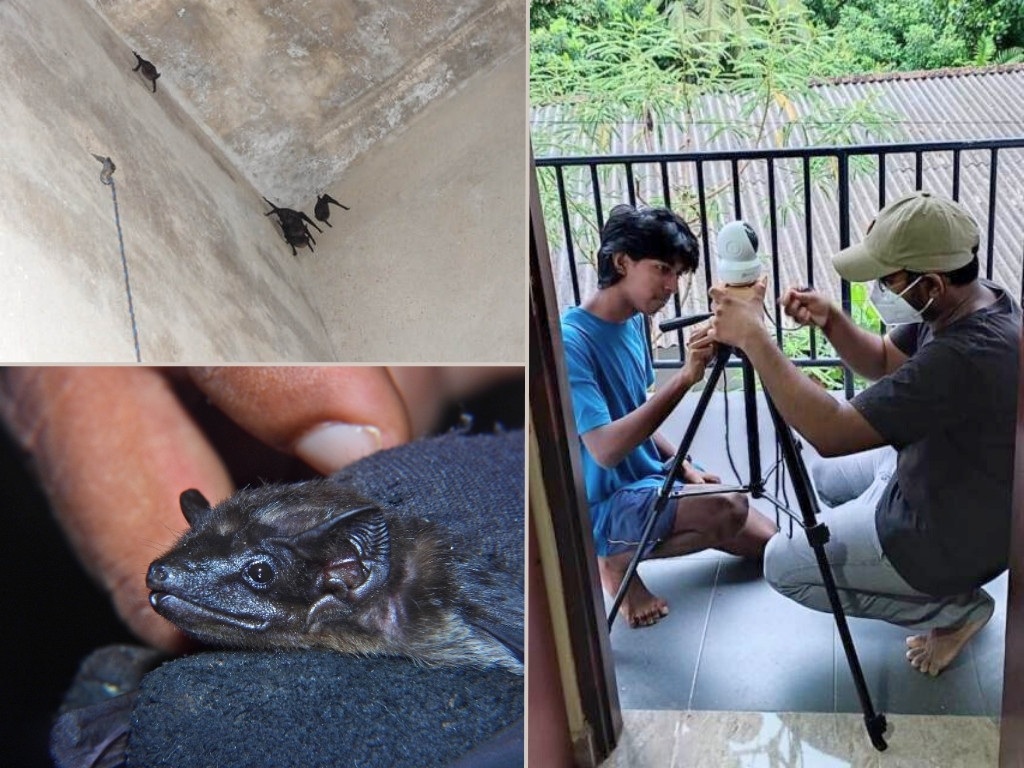
My fascination with wildlife started with snakes. I spent hours doing self-studies on them through iNaturalist. Then, COVID hit Sri Lanka, and my family moved to Arakawila (my village). Returning to my house a few months later, I discovered something incredible: in one of the abandoned rooms on the first floor, a small bat colony had made itself at home. I had no idea what species it was.
At first, I tried to photograph them with my phone. The results? Let's just say my "mobile photography era" officially ended there. I uploaded the photo to iNaturalist, and it was initially identified as a Taphozous bat.
Meanwhile, my family was not thrilled about sharing the house with bats. (In Sri Lanka, there's an old saying that bats inside a house bring bad luck.) But I was determined and wanted to keep them. Imagine flexing with friends like, "Yo, I have a bat colony in my house!"
Thanks to my sister's life-saving support (she literally funded it), I acquired a Nikon P950 Coolpix camera, marking the end of my mobile photography days. On the very first day with the camera, my mission was simple: photograph the colony. Weeks later, I uploaded the photos, and expert with the handle @jakob tentatively identified the species as Saccolaimus saccolaimus, a locally critically endangered bat in Sri Lanka.
His words: "Great find! If my identification is correct, it is one of the very few records of this species from Sri Lanka; see ResearchGate. Please note that my ID is tentative; I hope you arrived independently at this identification. Otherwise, I suggest leaving the ID unconfirmed for further assessment by an expert on Asian bats."
I tried contacting experts, but initially failed. Then, right when exams were looming, I got an email that changed everything:
Hi Pasindu,
I am interested in one of your iNaturalist observations, the Saccolaimus saccolaimus colony in your house. I am a bat researcher in Sri Lanka and am currently doing my PhD at the University of Ruhuna, studying the bioacoustics of Sri Lankan bats. I would love to record the echolocation calls of S. saccolaimus. Can you help?
Tharaka Kusuminda
I was over the moon. This was a critically endangered species, and it was my first encounter with a real-world scientist. I invited him over, and that's how we captured the colony, measured the bats, and photographed them for research, all with full permission from the Department of Wildlife Conservation.
The observation details are as follows: five individuals (four females, one male) were roosting inside the abandoned room, clinging to the side walls. The room had two openings; the larger door was used by the bats to access the roost. One female had some Nycteribiid bat flies (Family Nycteribiidae). The bats had dorsally black and dark chocolate brown fur with whitish markings.
This became the second confirmed record of S. saccolaimus roosting in a building in Sri Lanka and the first confirmed record of both sexes living together in a suburban area. Previously, S. saccolaimus was known to roost in hollow trees such as Kitul palms, Arecanut palms, and Coconut palms . Recent observations in human-made structures highlight the lack of suitable natural roosts in urban and semi-urban areas, and the need for both natural roost protection and artificial roost introduction.
This little backyard discovery launched a whole new chapter. I became part of Tharaka's research team, and we are now conducting a monitoring project on the behavioral ecology of the Naked-rumped Pouched Bat (Saccolaimus saccolaimus). What started as a casual curiosity transformed into meaningful research, youth conservation leadership, and citizen science engagement across Sri Lanka.
The funny part? All of this began with six bats in a room, a stubborn curiosity, and a Nikon P950. It's incredible how a tiny observation in a suburban backyard can grow into a journey that shapes your life and contributes to conservation.
Perhaps the bigger lesson is that you don't need remote forests to make groundbreaking discoveries. Sometimes, even your backyard is a treasure trove of wildlife waiting to be noticed. So next time you spot something unusual at home, don't shoo it away. It may be the beginning of a life-changing adventure in conservation.
Join our mailing list to get notified about upcoming training opportunities, live webinars, quarterly grant offerings, product releases, and more.
Thank you for signing up to our mailing list.
You can unsubscribe or change your email settings at any time by clicking "Manage Preferences" link at the bottom of any mailing list emails we send you.
