
Comparing the Song Meter Mini Bat and Song Meter Mini Bat 2
The Song Meter Mini Bat 2 builds on the first-generation Song Meter Mini Bat by taking into account the feedback we have received from users running all types of deployments since the original product's launch in 2020.
The first- and second-generation recorders share much in common, and users coming from the original Song Meter Mini Bat will find the new Song Meter Mini Bat 2 to be very familiar. However, there are several major improvements worth highlighting, as well as functional differences that we recommend keeping in mind, particularly if you have a mixed fleet of first- and second-generation recorders.
Improved Enclosure
The Song Meter Mini Bat 2's enclosure has been completely redesigned. It is now more robust and easier to use.
While the first-generation Song Meter Mini Bat's enclosure was comprised of a separate base and lid, the enclosure of the Song Meter Mini Bat 2 is joined by a permanent hinge, and the new, lockable latch can be more easily operated with one hand. The latch can be locked close using an appropriately sized padlock, without requiring an additional security bracket.
The optional Security Bracket accessory for the first-generation Song Meter Mini Bat is not compatible with the Song Meter Mini Bat 2. Instead, the enclosure itself can be locked shut using a padlock.
The seal around the edges of the enclosure has been improved, and the enclosure (excluding acoustic stub mics) meets IP67 standards. This means it can withstand temporary submersion in water up to a depth of one meter without water intrusion. Note that installed acoustic stub mics can be damaged by underwater submersion, but they are protected against rain.
The back of the Song Meter Mini Bat 2 features a tripod-style, ¼”-20 threaded mounting point. This enables you to mount the recorder using many accessories designed for trail cameras and similar devices.
For more detailed information on the new enclosure, see Song Meter Mini Bat 2 Hardware.
Battery Configuration
The original Song Meter Mini Bat had one built-in AA battery tray, allowing the use of four AA batteries by default. The optional Lithium-ion Lid accessory replaced the standard lid with a compartment for up to six 18650 lithium-ion batteries, installed in pairs.
The Song Meter Mini Bat 2 now comes in two entirely separate versions, AA and Li-ion, each with a permanently installed battery tray for its respective battery type. See Battery Configuration Versions for more detail.
The Song Meter Mini Bat 2 is not compatible with the Lithium-ion Lid accessory for the first generation Song Meter Mini Bat.
AA Batteries
The Song Meter Mini Bat 2 AA can be used with either four or eight AA batteries. With eight AA batteries installed, you can record for twice as long as the original Song Meter Mini Bat could with AA batteries. Ribbons built into the AA battery trays allow you to remove batteries much more easily.
AA batteries in the Song Meter Mini Bat 2 AA are wired in two parallel sets of four batteries. This means that the recorder's Status screen will show the same voltage reading whether four or eight brand-new batteries are installed. The voltage reading on a recorder with eight batteries will decline at half the speed compared to a recorder with four batteries.
Lithium-Ion Batteries
The Song Meter Mini Bat 2 Li-ion can be used with any number of 18650 batteries between one and six. Unlike the first-generation Song Meter Mini Bat's Lithium-ion Lid accessory, 18650 batteries do not need to be installed in pairs.
The original Song Meter Mini Bat's Lithium-Ion Lid used pairs of 18650 batteries in parallel with other pairs of batteries. The new Song Meter Mini Bat 2 Li-ion uses individual 18650 batteries in parallel with each other. This means that the voltage reading on the Song Meter Mini Bat 2 Li-ion's Status screen is half that of the original Song Meter Mini Bat, despite having the same possible deployment time.
For example, with six fully charged 18650 batteries, a first-generation Song Meter Mini Bat will display a voltage of 8.4 V, while a Song Meter Mini Bat 2 will display a voltage of 4.2 V. Both recorders have the same total energy available despite the difference in voltage reading.
New Ultrasonic Microphone
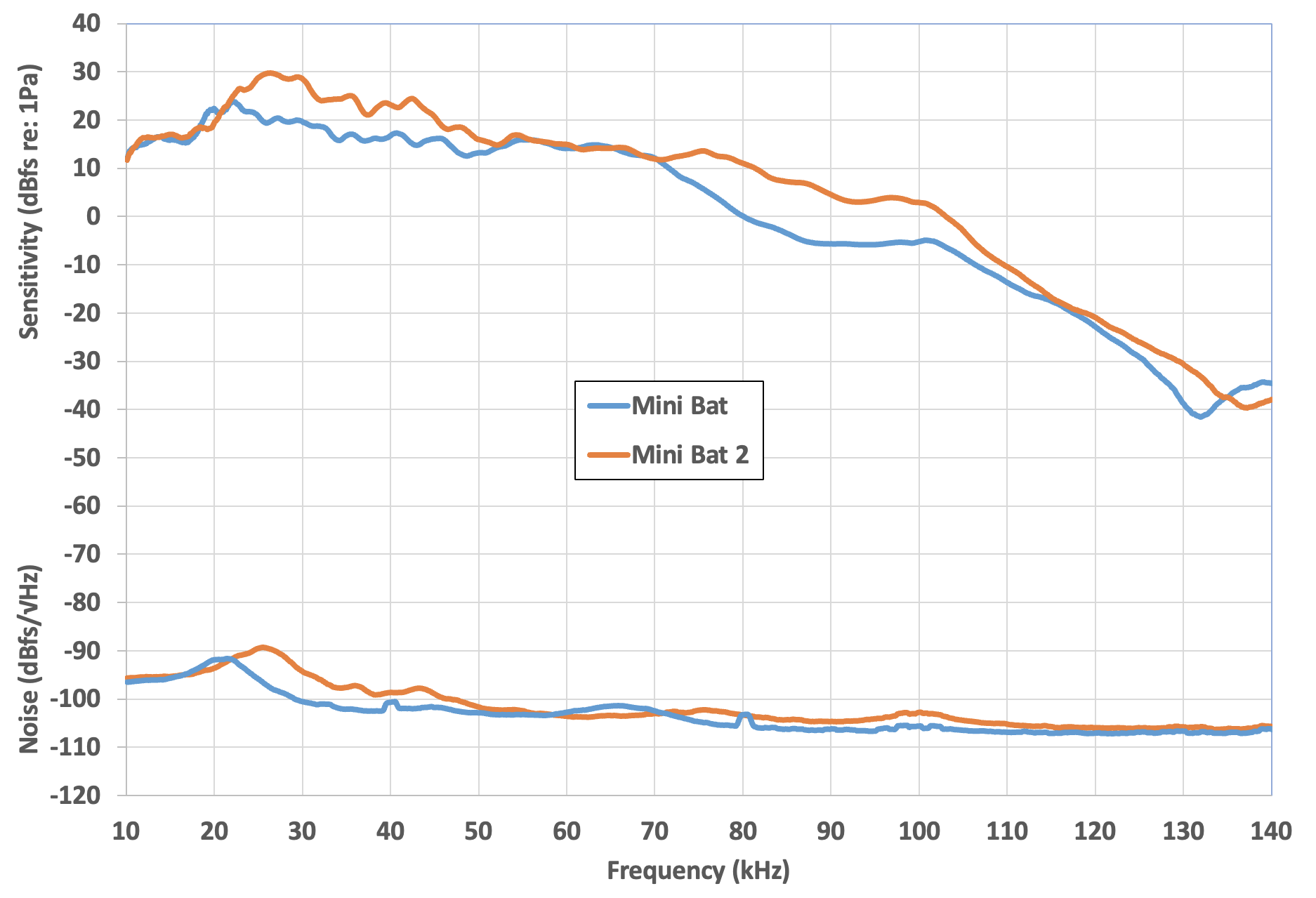
The Song Meter Mini Bat 2 uses a different microphone than the original Song Meter Mini Bat. While the characteristics are generally very similar, it is approximately 10 dB more sensitive in the ranges 20-50 kHz and 70-105 kHz.
Configuration and Firmware Files are Cross-Compatible
The Song Meter Mini Bat and Song Meter Mini Bat 2 run the same firmware versions, meaning both will be improved by the same new features and bug fixes as we release firmware updates.
Both recorders can also share configuration files. A configuration file exported from a Song Meter Mini Bat can be imported into a Song Meter Mini Bat 2, and vice-versa. This provides a simple way to maintain consistent settings across a mixed fleet of recorders.
Configuration files that include the use of an optional second microphone cannot be completely imported into a recorder that does not have the second microphone installed. Relevant settings will be altered to only use the available microphone.